
Walk the long broad paths or relax with a picnic amongst our ancient trees.
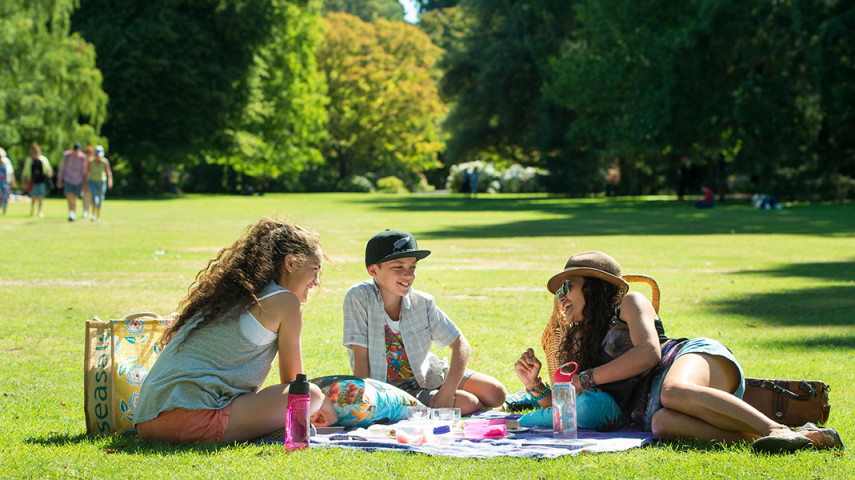
One of the Gardens’ favourite outdoor ‘rooms’, the great Archery Lawn is named for its use in the 1880s by the local archery club.
Situated adjacent to the Herbaceous Border, the lofty walls of cork oak and giant sequoia trees provide a perfect sheltered picnic space.
This avenue of lime or linden trees (Tilia europaea) was established in 1917 and named for Henry Joseph Beswick, a former Chairman of the Christchurch Domains Board and Mayor of Christchurch in 1896.
Beswick’s Walk is undoubtedly one of the Gardens most stunning experiences. Throughout the autumn, the leaves of the majestic lime trees turn a bright golden-yellow before gently falling to form a magical golden carpet. During mid-summer when the lime trees are in full flower, their scent hangs heavily in the warm air attracting a myriad of bees.
 The Daffodil Woodland extends over two hectares on the south-west side of the Avon River in Hagley Park.
Between 1864 and 1930, the Canterbury Horticultural and Acclimatisation Society leased part of the woodland, keeping a menagerie of unusual animals here including silk worms, deer, ferrets, kangaroos, angora and cashmere goats, opossums, monkeys, wallabies, llamas, a lemur, a tortoise, a Californian bear and even an emu called Jack. Enjoyed by many people, this popular area was known for a while as The Zoo.
In 1933, Park Curator James McPherson, initiated the planting of daffodils among the established oak and ash trees. In the first year, 16,000 bulbs were publically donated and planted. By 1943, 500,000 bulbs had been planted and these provide the basis of what is today one of the most popular springtime attractions in New Zealand.
 This area of two hectares extends in a westerly direction from the Primula Garden and was named after Mr R. J. S. Harman, an executive committee member of the Christchurch Domains Board.
The established plantings include many fine specimens of ash (Fraxinus), hornbeam (Carpinus), oak (Quercus) and sycamore (Acer). These wonderful trees are much admired for the cool shade they provide in summer and their attractive autumn colours.
 Visitors entering the Gardens via Rolleston Avenue entrance will notice at the far end of the Armstrong lawn a fine group of maritime pines or Pinus pinaster.
Elevated on a naturally occurring sand dune, the circle of pines form a striking feature on what is now called the Pine Mound.
 The establishment of the Pinetum began prior to World War II. The southern section however, remained the refuse dump for the Botanic Gardens until 1961, when it was cleared and planted with conifers.
Conifers are an attractive and economically important group of plants, the majority of which are evergreen with predominantly narrow needle like leaves.
The Pinetum has matured to include an extensive collection which includes many species and cultivars of cedar, cypress (Cupressus), fir (Abies), larch (Larix), juniper (Juniperus), pine (Pinus) and spruce (Picea).
 The Woodland Garden was developed in 1955 using a small stream as a centrepiece.
A selection of small trees and large shrubs provide just the right semi-shaded conditions to support an extensive collection of colourful primulas. They grow happily in association with groupings of many other interesting, moisture loving plants.
The Christchurch Botanic Gardens started with the planting of an oak to celebrate a Royal wedding in 1863, and over the years, we have been honoured by visits from members of the British Royal Family and many other notable international and national visitors.
The volunteer Friends of the Christchurch Botanic Gardens organisation has developed a leaflet that allows you to learn more about the trees planted for commemorative purposes.
Download the Friends of the Botanic Gardens commemorative trees brochure [PDF, 4.1 MB].
Related news

Whip the garden into shape this winter
The leaves may be falling and the frosts starting to bite but it’s still a busy time of year at the Christchurch Botanic Gardens, we caught up with one of the curators there for some winter gardening advice.
27 May 2026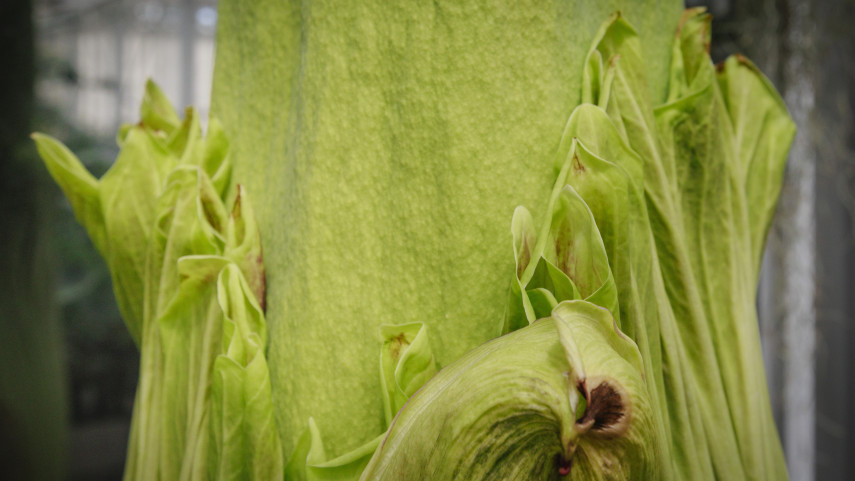
Corpse flower comes to life
Cantabrians have the chance to see a rare flowering tropical plant that smells of rotting flesh and hardly ever blooms.
15 Dec 2025
Free outdoor music returns to Botanic Gardens
Summer Sundays is back with a vibrant mix of live music at the Botanic Gardens this summer.
18 Nov 2025