
Christchurch City Council has proposed to become a unitary authority under the Government's Head Start Pathway reform process.

The Council voted on 5 August to form a unitary authority, absorbing Environment Canterbury’s functions. Under the reform, regional councillors will not be re-elected as of 2028.
View a recording of the 5 August Council meeting.(external link)
The Council’s proposal was submitted to the Government on 7 August 2026. The proposal was submitted alongside the councils of Hurunui, Waimakariri, and Selwyn as a single submission.
The submission was a collective endorsement to establish three separate unitary councils. They are:
- Hurunui and Waimakariri councils to establish a North Canterbury Council.
- Christchurch City Council to become a unitary authority within its existing boundaries.
- Selwyn District Council to become a unitary authority within its existing boundaries.
You can read the joint letter from the four councils below:
- Head Start Outline Proposal Joint Letter [PDF, 134 KB]
Christchurch City Council's proposal and implementation conditions can be read below:
- Head Start Proposal [PDF, 202 KB]
- Head Start Outline Proposal Implementation Conditions, Commitments and Expectations [PDF, 57 KB]
Cabinet will review proposals in September to decide whether they will progress.
Proposals must show deliverability and that they support the new planning system, simpler local governance, economies of scale, and maintain local voice.
Next steps in the Head Start Pathway process:
- Cabinet to review proposals in September 2026.
- Accepted proposals move into the detailed design phase from October 2026 to March 2027.
- Cabinet final approval in May 2027.
- Legislation to reform local government will be implemented before local body elections in October 2028.
- In regions where no proposal is submitted or accepted, an interim process will be in place from the 2028 elections.
The Council’s Head Start proposal is an outline of the direction Christchurch wants to take. It does not determine all the details of how a new unitary council would operate.
If the Government accepts the proposal in principle, it would move into a detailed design phase. Under the Government’s current timetable, this is expected to run from October 2026 to March 2027. Cabinet would then consider the detailed proposal and make final decisions in 2027. Legislation would be needed before any new arrangements could take effect.
Moving to detailed design would not mean an immediate change to Council services, rates or representation.
What a detailed design will look at
There are several important matters that cannot be decided at the outline proposal stage. Detailed design would work through issues, including:
- How the regional council functions would transfer to Christchurch.
- Which functions Christchurch would deliver itself, and which would need joint or shared arrangements with neighbouring councils.
- The transfer of staff, assets, liabilities, contracts, systems and information.
- The financial impacts, including rates, debt and transition costs.
- Representation, wards and the role of community or local boards.
- Arrangements with mana whenua and the continuation of Treaty settlement commitments.
- How services would continue without disruption during the transition.
- How cross-boundary services such as public transport, catchments, flood management and regional planning would work.
The Council would also seek formal community involvement when we get to this stage, particularly on representation, financial impacts, services and transition arrangements.
What could change for Christchurch
Under the Christchurch City unitary proposal, Christchurch’s current council boundary would remain the same.
The main change would be that Christchurch City Council would also take responsibility for regional council functions within the city that are currently carried out by Environment Canterbury. This would bring local and regional responsibilities together within one council.
This could include responsibilities relating to areas such as:
- Freshwater and environmental management.
- Environmental monitoring and regulation.
- Flood and hazard management.
- Biosecurity and biodiversity.
- Regional and public transport functions.
- Regional planning and infrastructure coordination.
Not every function would necessarily be delivered by Christchurch alone. Rivers, groundwater, public transport, civil defence and other systems cross council boundaries, so some services would still require joint arrangements with other Canterbury councils and the Crown.
What would not change straight away
For most residents, day-to-day Council services would continue as normal while detailed design and transition work takes place.
The proposal is based on a staged transition. The aim would be to have the governance arrangements for the new unitary council in place for the 2028 local elections, but full organisational change would take longer. Services, staff, systems and regional functions would be transferred in stages where needed to protect service continuity.
There is also no decision at this stage about what individual households would pay in rates. Financial impacts would need to be assessed through detailed design before final decisions are made.
Visit the links below for Head Start proposals or updates from other Canterbury councils regarding the reforms:
- Ashburton District Council(external link)
- Hurunui District Council [PDF, 1.8 MB](external link)
- Kaikoura District Council(external link)
- Mackenzie District Council(external link)
- Selwyn District Council [PDF, 1.8 MB](external link)
- Timaru District Council(external link)
- Waimakariri District Council [ PDF, 1.8MB](external link)
- Waimate District Council(external link)
- Waitaki District Council(external link)
- Council votes not to amalgamate(external link) – 5 August
- Residents’ priorities revealed as Head Start decision deadline approaches(external link) – 28 July
- Time to share your priorities for local government re-organisation –(external link) 17 July
- Survey on Council reorganisation upcoming : Newsline(external link) – 14 July
- Community’s priorities for local government reform presented(external link) – 1 July
- Local government reform sets council on a new path(external link) – 2 June
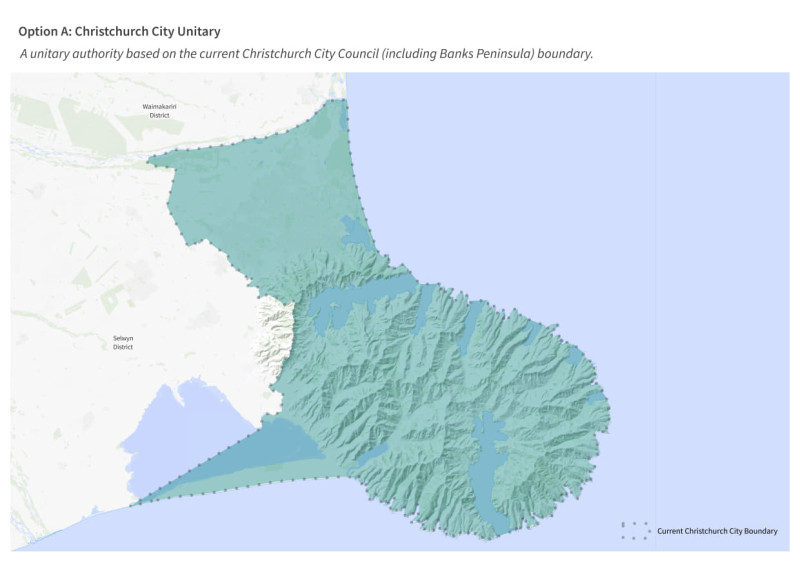
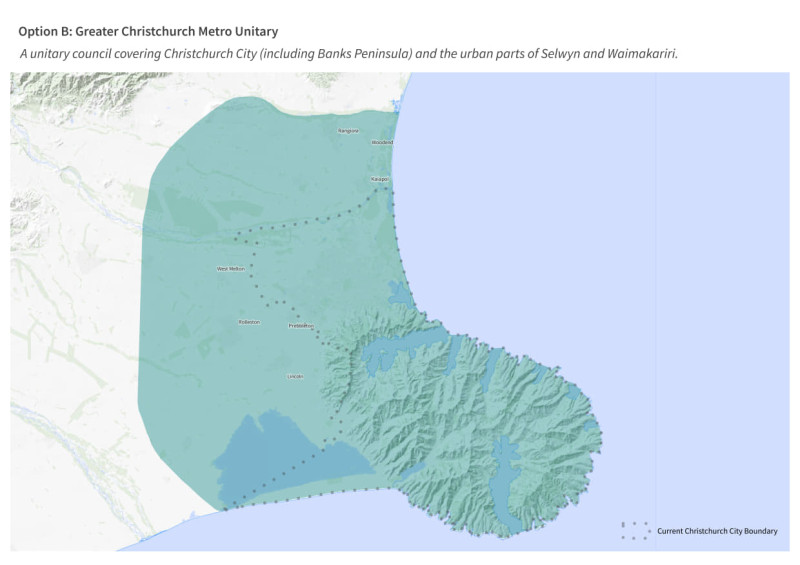
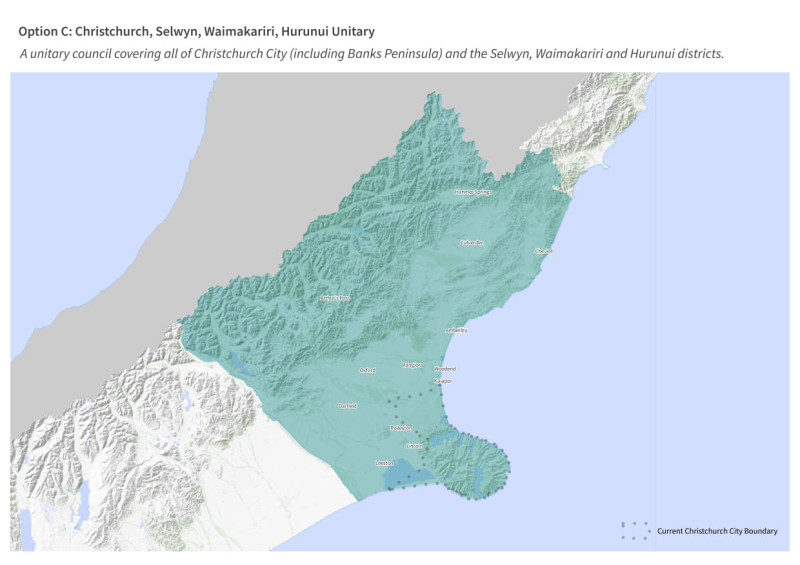
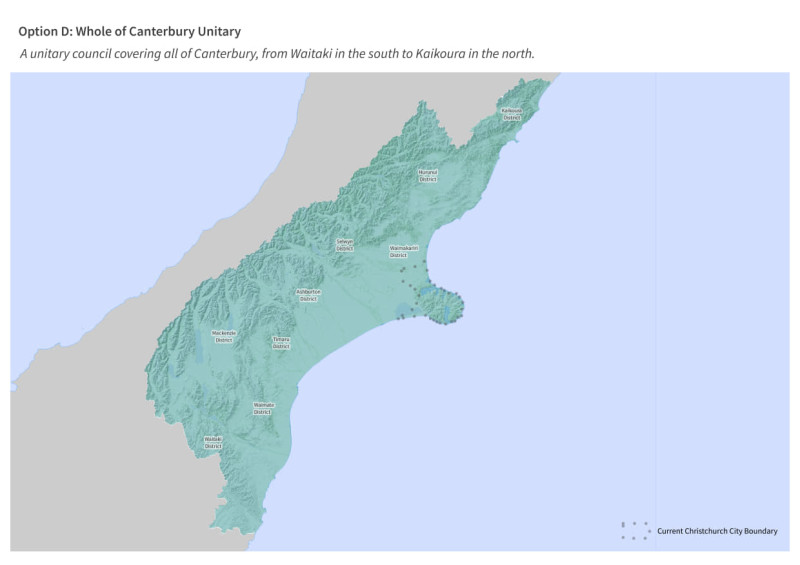
The Council considered four potential options for the reorganisation of local government. The Council agreed on 5 August to submit Option A under the Head Start Pathway process.
Option A: Christchurch City unitary
Christchurch City Council and Environment Canterbury functions.
Option B: Greater Christchurch metro unitary
Christchurch, metro Selwyn, metro Waimakariri and Environment Canterbury functions.
Option C: Christchurch, Selwyn, Waimakariri and Hurunui unitary
Four territorial councils and Environment Canterbury functions.
Option D: Whole of Canterbury unitary
Ten territorial councils and Environment Canterbury functions.
On 5 May, the Government announced the Head Start Pathway, giving councils until 9 August to submit proposals for local government amalgamation within their regions.
Cabinet will consider proposals in September. Proposals that are approved by Cabinet will move onto a detailed design phase to work out the details of the reorganisation of council functions in their area.
Councils that were unable to provide a suitable proposal via the Head Start process will have an interim body put in place by the Government in 2028 to govern regional functions and lead the reorganisation of local government.
Read more:
A public pulse survey(external link) inviting residents to consider possible approaches for how Christchurch and Canterbury could be organised closed on Sunday 26 July 2026. A total of 5628 respondents took the survey.
The results indicated a preference for an approach that supports sustainable long-term growth across both Christchurch and the wider region. View the survey results [PDF, 654 KB].
We also sought feedback from residents in June about their priorities ahead of a decision about a proposal. More than 7300 people responded to our early engagement online survey(external link).
The June survey results revealed broad alignment across the community on some key outcomes that any changes should aim to achieve, including:
- Improved planning and infrastructure coordination.
- Sustainable and reliable essential services.
- A focus on affordability.
- Addressing growth pressure on the city.
Respondents were concerned about decision-making and how local needs would be reflected in any new governance model, as well as the need to balance regional approaches with local priorities. The Mayor and councillors were updated on the survey results on 1 July 2026.
Read the full results of the public survey [PDF, 334 KB].