
Ngā kaitia, ngā kaikauhoe me ngā kūkūtai. Take a trip to Travis Wetland, Christchurch's largest freshwater wetland and a precious habitat for native plants and creatures.
Book a Learning Through Action school programme
Risk analysis and management information (RAMS) will be sent out once a programme booking is confirmed. If you require this at any other stage please email LTA@ccc.govt.nz or contact us(external link).

| Year level | Years 3 to 10 |
|---|---|
| Curriculum level | Levels 1 to 5 |
| Availability | Year-round |
| Times | 9.30am to 12noon, or 12.15pm to 2.30pm |
| Site | Travis Wetland Reserve |
| Cost | Free |
| Number of students | Maximum of 35 |
| Special requirements | In wet conditions, gumboots are recommended |
- Biodiversity of a wetland.
- The interdependence of the plants and animals in a wetland system.
- Native and introduced species.
- Food chains.
- Personal and social responsibility for action.
Take a trip to Ōruapaeroa, Travis Wetland; Christchurch’s largest freshwater wetland.
This is the ideal place to learn about the important role wetlands play in providing precious habitats for native plants and creatures.
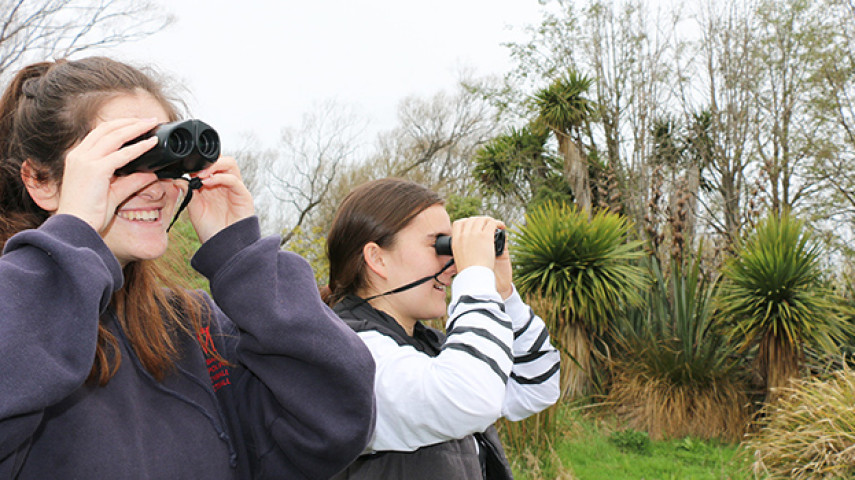
Students go pond-dipping and get up close and personal with aquatic invertebrates, and get in behind a pair of binoculars to observe local birdlife.
Taking a look at food chains allows students to understand how all this new information is connected and see the potential human impact on some of our green spaces.
We are learning to:
- Identify a range of bird life and stream invertebrates.
- Describe the relationships between organisms in the wetland habitat.
- Describe why wetlands are important.
- Identify choices they can make to look after the wetland habitat.
Using language, symbols and texts
Students will explore the history of Travis Wetland through visual, oral and written texts; communicating and applying their learning through activities.
Thinking
Students will employ critical thinking to make connections regarding the interdependence of creatures which live in a wetland environment.
Managing self
Students will manage their learning and think and act independently in an outdoor near-water environment.
Participating and contributing
Students are invited to become actively involved in contributing to the quality and sustainability of the Travis Wetland ecosystem.
Relating to others
Students will work collaboratively and supportively to complete tasks; take turns and support their classmates.
| Curriculum area | Strand and level | Objective |
|---|---|---|
| Science Pūtaiao |
Nature of Science Levels 1 to 5 |
Investigating in science Communicating in science Participating and contributing |
| Living World Levels 1 to 5 |
Life processes Ecology Evolution |
|
| Social Sciences Tikanga ā-Iwi |
Levels 1 to 5 | Social studies |
| Health and Physical Education Hauora |
Personal Health and Physical Development Level 2 |
Safety management |
Related news

Helping kids become champions for our eels
An education and action programme helping kids learn about their local waterways and how they can improve them to help eels/tuna has been a huge success.
19 Aug 2026
Recognising guardians of the land
Paul Tamagushiku has protected, nurtured and cared for Christchurch parks for 38 years – earning him the title of the Council’s longest standing ranger.
31 Jul 2026
Īnanga relocated ahead of in-stream works
Thousands of nationally threatened native freshwater fish and dozens of at-risk lizards have been relocated to allow for restoration work at Halswell’s Greens Stream.
20 Jul 2026