
Explore the issue of coastal erosion - through natural processes and human interference.
Book a Learning Through Action school programme
Risk analysis and management information (RAMS) will be sent out once a programme booking is confirmed. If you require this at any other stage please email LTA@ccc.govt.nz or contact us(external link).

| Year level | 9 to 13 |
|---|---|
| Curriculum level | 4 to 8 |
| Availability | Year-round |
| Times | 9.30am to 12 noon |
| Site | New Brighton Beach, North New Brighton Beach |
| Cost | Free |
| Number of students | Maximum of 35 |
| Special requirements | None |
- Coastal management techniques (sand fencing, vegetation, gabions, groynes, sea and rock walls).
- Erosion.
- Values positions over the height of the sand dunes.
- Human impacts along the Pegasus Bay Coast.
The Coastal Management programme has both an interactive indoor session, and a practical, hands-on session where students will be outside on the beach.
Students will have the chance to enter a debate considering the future of the coastal environment taking on the perspective of a wide range of community members.
Consideration will be given to the consequences of our interaction with the coastal area (past and present) and the variety of ways we can minimise our impact on this environment.
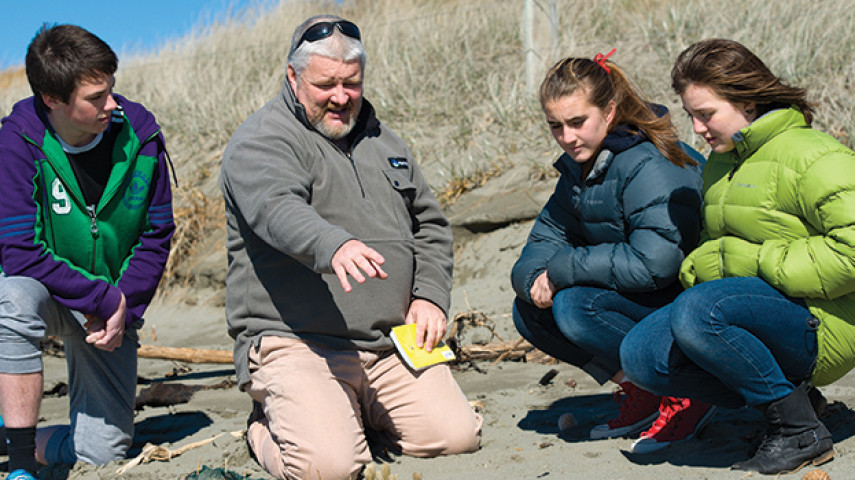
Students will build a mini-dune system and beach profile. They will work with a coastal park ranger to manage their beach area; learning about and using a variety of coastal management techniques, including sand fences, vegetation, groynes, gabions and sea walls.
Students will also have a chance to make their own mark in protecting and enhancing the environment, by participating in a beach clean-up or dune planting exercise, depending on the time of year.
An option is available to introduce your students to the ecological processes at the beach specifically focusing on the botanical biodiversity present. Please include this request in the 'Additional information' box in the booking form.
We are learning to:
- Identify key reasons why coastal environments are special places.
- Explain how people have used the coast and how the coast has changed from past to present.
- Name at least three techniques used to prevent and reduce coastal erosion.
- Identify at least three interest groups related to dune management in the coastal region and name at least one of their interests or concerns with how the dunes are managed.
- Identify an action that they can take to reduce dune erosion.
Using language, symbols and texts
Students will interpret images, symbols and text to understand the dynamic nature of Christchurch’s changing coastline.
Thinking
Students will use critical and evaluative processes to reflect on and re-evaluate their ideas and values surrounding contemporary coastal issues.
Managing self
Across a variety of collaborative learning activities, students will manage their learning and behaviour and act in an appropriate and safe manner.
Participating and contributing
Students will join a discussion around their values and opinions of coastal issues and be expected to explain or expand on their ideas.
Relating to others
Students will work collaboratively and supportively to complete tasks; listen and share opinions and ideas, and support their classmates.
| Curriculum area | Strand and level | Objective |
|---|---|---|
| Science Pūtaiao |
Nature of Science Levels 4 |
Investigating in science Communicating in science Participating and contributing |
| Living World Levels 4 to 6 |
Ecology | |
| Technology Hangarau |
Technological Practice Levels 2 to 8 |
Brief development Outcome development and evaluation |
| Technological Knowledge Levels 2 to 8 |
Technological products Technological systems |
|
| Nature of Technology Levels 2 to 5 |
Characteristics of technology Characteristics of technological outcomes |
|
| Social Sciences Tikanga ā-Iwi |
Levels 2 to 8 | Social studies Economics |
| Health and Physical Education Hauora |
Healthy Communities and Environments Levels 2 to 4 |
Societal attitudes and values Community resources People and the environment |
Level 1
| Subject | Standard |
|---|---|
| Biology | 1.2 AS90926 |
| Geography | 1.1 AS91007 1.3 AS91009 1.4 AS91010 1.6 AS91012 |
| History | 1.2 AS91002 1.4 AS91004 1.5 AS91005 |
| Science | 1.10 A 90949 1.12 AS90951 1.13 AS90952 |
Level 2
| Subject | Standard |
|---|---|
| Biology | 2.3 AS91155 |
| Business Studies | AS90843 |
| Earth and Space Science | 2.3 AS91189 2.7 AS91193 |
| Education for Sustainability | 2.2 AS90811 2.3 AS90813 |
| Geography | 2.1 AS91240 2.3 AS91242 2.4 AS91243 2.6 AS91245 |
| History | 2.1 AS91229 2.2 AS91230 2.4 AS91232 |
| Social Studies | 2.1 AS91279 |
Level 3
| Subject | Standard |
|---|---|
| Biology | 3.2 AS91602 3.3 AS91603 |
| Earth and Space Science | 3.2 AS91411 3.4 AS91413 |
| Education for Sustainability | 3.2 AS91735 3.3 AS91736 3.4 AS90831 |
| Geography | 3.1 AS91426 3.6 AS91431 |
| History | 3.1 AS91434 3.2 AS91435 |
| Social Studies | 3.1 AS91596 |
Related news

Recognising guardians of the land
Paul Tamagushiku has protected, nurtured and cared for Christchurch parks for 38 years – earning him the title of the Council’s longest standing ranger.
31 Jul 2026
Ready, set, play! Exploring our city's playgrounds
Get the kids outside these school holidays and check out some of the great playgrounds around the city.
13 Jul 2026
Future of Apollo Projects Stadium site to be decided
With One NZ Stadium up and running, it’s time to decide what to do with the temporary stadium and infrastructure.
8 May 2026