
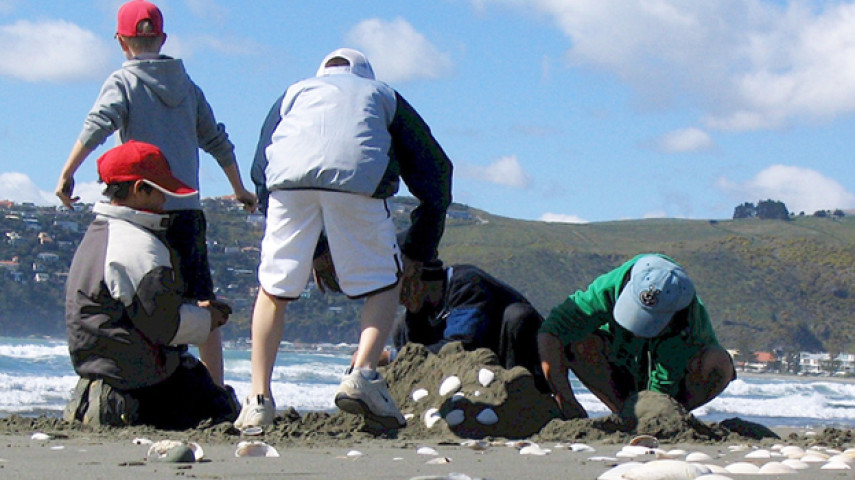
In this programme, students investigate the biodiversity and erosion process of the dune system and engage in hands-on learning to create their own mini sand dunes.
Book a Learning Through Action school programme
Risk analysis and management information (RAMS) will be sent out once a programme booking is confirmed. If you require this at any other stage please email LTA@ccc.govt.nz or contact us(external link).

| Year level | 3 to 8 |
|---|---|
| Curriculum level | 1 to 4 |
| Availability | Year-round |
| Times | 9.30am to 11.30am or 12.30pm to 2.30pm |
| Sites | Spencer Park Beach Waimairi Beach North New Brighton Beach New Brighton Beach South New Brighton Beach Sumner Beach |
| Cost | Free |
| Number of students | Maximum of 35 |
- Interdependence and biodiversity of sand dunes.
- Importance of sand dunes from a biological and human perspective.
- Natural and human forces affecting sand dune systems.
- Personal and social responsibility for action.
Students will take a hands-on approach to explore the management and stabilisation of sand dunes by building their own mini-dune system and discovering what natural and human forces affect them.
They will investigate the difference between native and introduced sand binders (plants) and discover a whole new world of creatures living in and around our sand dunes.
Students will consider different perspectives on the value of these coastal resources and what actions they can take to protect these natural spaces.
We are learning to:
- State key reasons why coastal environments are special places.
- Explain how sand dunes are formed.
- Identify the three main causes of erosion and accretion of sand dunes.
- Identify flora and fauna living in coastal environments.
- Build a simple dune system.
- Discuss differing values positions regarding sand dunes.
- Identify key ways to protect dune ecosystems.
Using language, symbols and texts
Students will interpret language and visual clues to identify examples of biodiversity
Thinking
Students will:
- Expand their knowledge around NZ biodiversity.
- Use creative thinking and problem-solving skills.
- Work in a group to explore concepts around dune accretion, erosion and protection.
- Process instructions and information.
Managing self
Students will work as part of a group to take on challenges and achieve a goal. For example, building a mini-dune with appropriate protection measures.
Participating and contributing
Students will be actively involved in decisions that affect the community (beach use and protection).
Relating to others
Students will work as part of a group to take on challenges and achieve a goal. For example, building a mini-dune with appropriate protection measures.
| Curriculum area | Strand and level | Objective |
|---|---|---|
| Science Pūtaiao |
Nature of Science Levels 2 to 5 |
Investigating in science Participating and contributing |
| Living World Levels 2 to 4 |
Life processes Ecology |
|
| Living World Level 5 |
Ecology | |
| Planet Earth and Beyond Levels 2 to 4 |
Earth Systems | |
| Social Sciences Tikanga ā-Iwi |
Levels 2 to 5 | People and places Use of resources Community |
| Health and Physical Education Hauora |
Levels 2 to 5 | A2 Regular physical activity D2 Community resources |
Related news

Recognising guardians of the land
Paul Tamagushiku has protected, nurtured and cared for Christchurch parks for 38 years – earning him the title of the Council’s longest standing ranger.
31 Jul 2026
Ready, set, play! Exploring our city's playgrounds
Get the kids outside these school holidays and check out some of the great playgrounds around the city.
13 Jul 2026
Future of Apollo Projects Stadium site to be decided
With One NZ Stadium up and running, it’s time to decide what to do with the temporary stadium and infrastructure.
8 May 2026